




Every child in your care is on a unique developmental journey. As a preschool owner, you see that journey up close every single day. But when a parent asks, “Is my child where they should be?”, can your team answer with confidence, or only with a feeling?
Picture this. It is open day. A mother sits down with your Nursery 1 teacher and says quietly, “His cousin is already talking in full sentences. Is my son behind?” The teacher smiles and says, “He is doing fine.” The mother leaves with a smile on her face and a worry in her heart.
A child milestone tracker changes that conversation. Instead of “he is fine”, your teacher can say, “This term he started joining other children in play, he now asks ‘why’ questions all day, and the next thing we are working on is holding his crayon with his fingers.” That is the kind of answer that builds trust, and trust is what keeps families in your school.
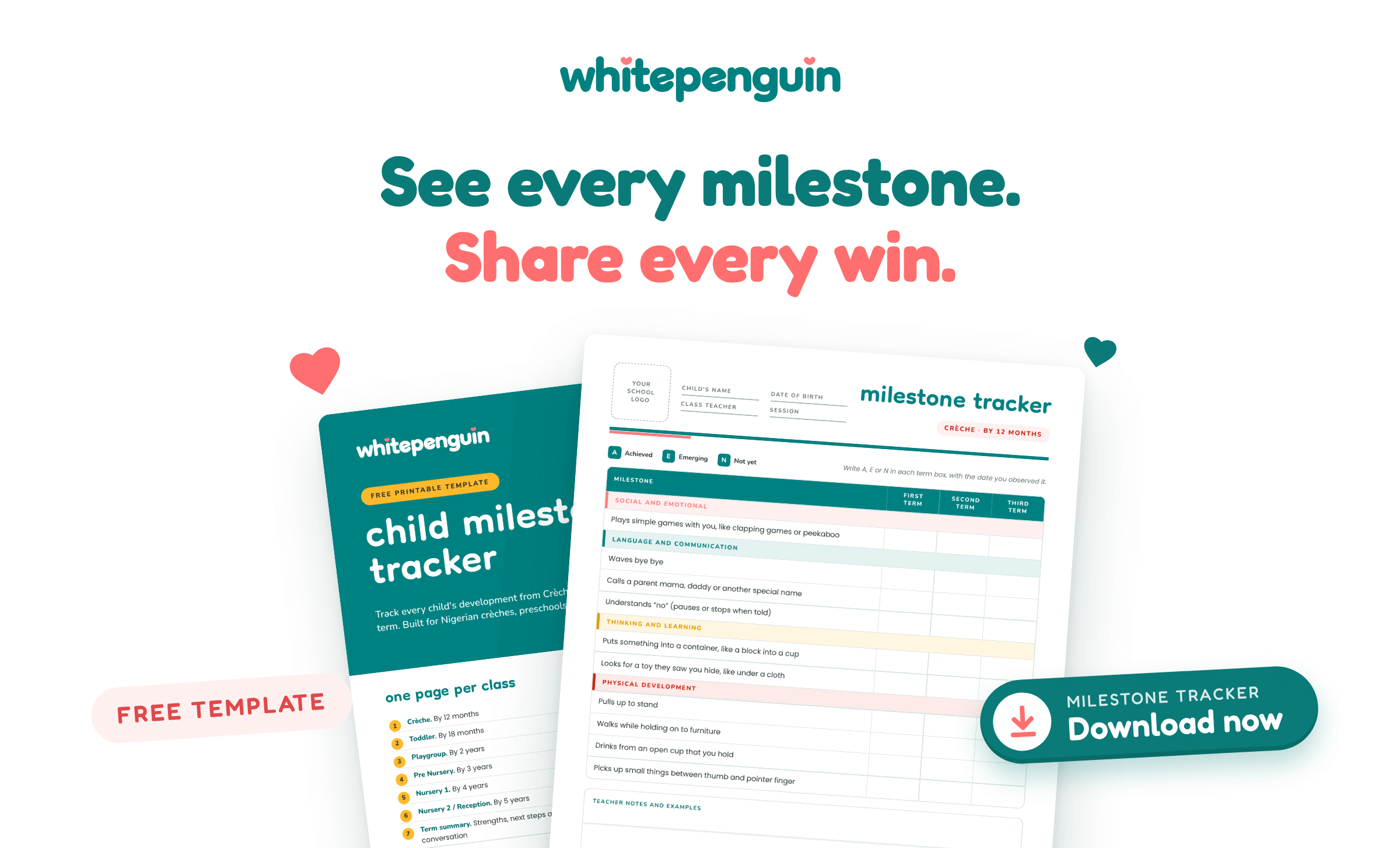
In this guide, you will learn what a child milestone tracker is, the milestones to watch from crèche to reception, how to use a tracker in a busy Nigerian classroom, and how to talk to parents when a child needs extra support. At the end, you can download our free Child Milestone Tracker template.
What is a child milestone tracker?
A child milestone tracker is a simple record of the skills a child shows as they grow: how they play, talk, think, move and relate to other people. Your teachers observe the child during everyday activities and mark which milestones the child has achieved, which are just emerging, and which have not appeared yet.
Developmental milestones are things most children, 75% or more, can do by a certain age. They give your team a shared, evidence based picture of what to expect, instead of guessing or comparing children to each other.
Why every Nigerian preschool needs one
- Parents see the value of your school. When parents see real progress written down each term, your fees stop looking like a cost and start looking like an investment.
- Concerns are spotted early. The first five years are when the brain develops fastest. Noticing a delay at age two is far better than discovering it at age six.
- Better termly reports. Your progress report card becomes specific and honest, not a page of “good” and “very good”.
- Teachers know what to plan next. A child who is “emerging” in a skill tells the teacher exactly what to practise this week.
- A more professional school. Organised child records show inspectors and visiting parents that your school takes development seriously.
The four areas of child development
Our free tracker groups milestones into four areas. Together, they give a full picture of the child, not only their ABC and 123.
- Social and emotional. How the child plays with others, manages feelings, settles at drop off and shows care for friends.
- Language and communication. How the child understands words, speaks, asks questions, listens to stories and joins in songs and rhymes.
- Thinking and learning. How the child solves problems, remembers, explores, counts, names colours and recognises letters.
- Physical development. How the child moves, balances, runs and hops, and uses their hands to scribble, feed themselves and handle buttons.
Child development milestones from crèche to reception
Here are a few of the milestones on each page of our tracker. They are adapted from the CDC “Learn the Signs. Act Early.” checklists and matched to common Nigerian class names.
| Class | Age | Examples of milestones |
|---|---|---|
| Crèche | By 12 months | Waves bye bye, pulls up to stand, picks up small things between thumb and pointer finger |
| Toddler | By 18 months | Walks without holding on, tries to say three or more words, points to show you something interesting |
| Playgroup | By 2 years | Says two words together like “More water”, kicks a ball, notices when others are upset |
| Pre Nursery | By 3 years | Calms down within 10 minutes after drop off, asks “why” questions, says first name when asked |
| Nursery 1 | By 4 years | Speaks in sentences of four or more words, names a few colours, catches a large ball |
| Nursery 2 / Reception | By 5 years | Counts to 10, writes some letters of own name, hops on one foot, takes turns in games |
Source: CDC’s Developmental Milestones. Every child develops at their own pace, so use these as a guide, not a test.
How to use a milestone tracker in your classroom
- Give each child their own copy. Print the page for the child’s class plus the term summary page, and keep them in the child’s file.
- Observe during everyday activities. Watch during free play, meals, circle time, outdoor play and story time. Children show their real skills when they are relaxed, not when they are being tested.
- Mark each milestone once a term. Write A for achieved, E for emerging or N for not yet, with the date you saw it.
- Write short examples. “Built a tower of six blocks and counted them” is far more useful to a parent than a tick.
- Plan the next step. Use the emerging skills to choose activities for the coming weeks.
- Share progress with parents every term. Use the term summary page at open day or with your termly report card.
How to talk to parents when a child is behind
This is the conversation many Nigerian teachers avoid, often because parents fear their child will be labelled. Handled well, it is one of the kindest things your school can do.
- Talk privately. Never at the gate or in front of other parents.
- Start with strengths. Share two or three things the child is doing well before any concern.
- Be specific, not scary. Say “He is not yet putting two words together”, not “Something is wrong with him”.
- Never diagnose. Your role is to observe and share. Kindly suggest the parents discuss what you have seen with the child’s doctor or paediatrician.
- Act early. If a child is missing several milestones for their age, or loses skills they once had, raise it early rather than waiting for the next term.
- Agree a plan together. Write down what the school will do, what the family will try at home, and when you will check in again.
Common mistakes to avoid
- Turning it into a test. Asking a two year old to “perform” for a checklist rarely shows what they can really do.
- Comparing children. The tracker compares a child with typical milestones for their age, not with their classmates or cousins.
- Tracking only ABC and 123. Social and emotional skills like settling, sharing and taking turns matter just as much for school readiness.
- Ticking without observing. A milestone marked from memory at the end of term is a guess, not a record.
- Keeping it in a drawer. A tracker only builds trust when parents see it.
Paper trackers or digital records?
A printed tracker is a great place to start. The challenge comes when you have sixty children across five classes, three terms a year, and parents asking for updates on WhatsApp every week. Paper files get lost, and progress is hard to see at a glance.
That is why growing preschools move their records online. WhitePenguin keeps every child’s records, observations and parent updates in one simple app built for Nigerian crèches, preschools and nursery schools, so your team can see each child’s progress and share it with parents in minutes.
Book a free WhitePenguin demo to see how it works for your school.
Frequently asked questions
What are developmental milestones?
Developmental milestones are skills most children, 75% or more, can do by a certain age, such as waving bye bye by 12 months or counting to 10 by 5 years. They cover social and emotional skills, language, thinking and learning, and physical development.
At what ages should a preschool track milestones?
From the first day in crèche until the child leaves for primary school. Our free tracker has a page for Crèche (12 months), Toddler (18 months), Playgroup (2 years), Pre Nursery (3 years), Nursery 1 (4 years) and Nursery 2 or Reception (5 years).
How often should teachers update a milestone tracker?
At least once a term, with short notes during the term whenever a teacher sees a new skill. Share the summary with parents at the end of each term.
What should I do if a child is not meeting milestones?
Speak with the parents privately and kindly, share specific examples, and suggest they discuss your observations with the child’s doctor or paediatrician. Act early, especially if the child has lost skills they once had.
Is a milestone tracker the same as a diagnosis?
No. A milestone tracker supports observation and conversation with parents. Only qualified health professionals can assess or diagnose developmental delays.
Can I use this tracker with my progress report card?
Yes. The tracker gives your teachers the evidence, and the term summary page makes it easy to write a clear, specific termly progress report for each child.
Download Your Free Child Milestone Tracker Template
WhitePenguin builds practical, Nigeria specific tools for preschool owners who take every child’s growth seriously. Our free tracker covers all four areas of development, with one page for each class from Crèche to Reception and a term summary you can share with parents.