




It is 4:45pm. A man you have never seen walks into your crèche and says he has come to pick up little Tobi. He says Tobi’s mummy sent him. Your caregiver looks at you. You look at the file. The file says nothing.
Every proprietor in Nigeria has lived some version of this moment. Most of the time it ends well. But the only thing standing between you and a very bad day is one piece of paper: your admission form.
A good crèche admission form does far more than collect a child’s name and the school fees. It tells your team who may collect the child, what the child is allergic to, which vaccines the child has had, and who to call when Mummy’s phone is switched off. It protects the child, your staff and your business.
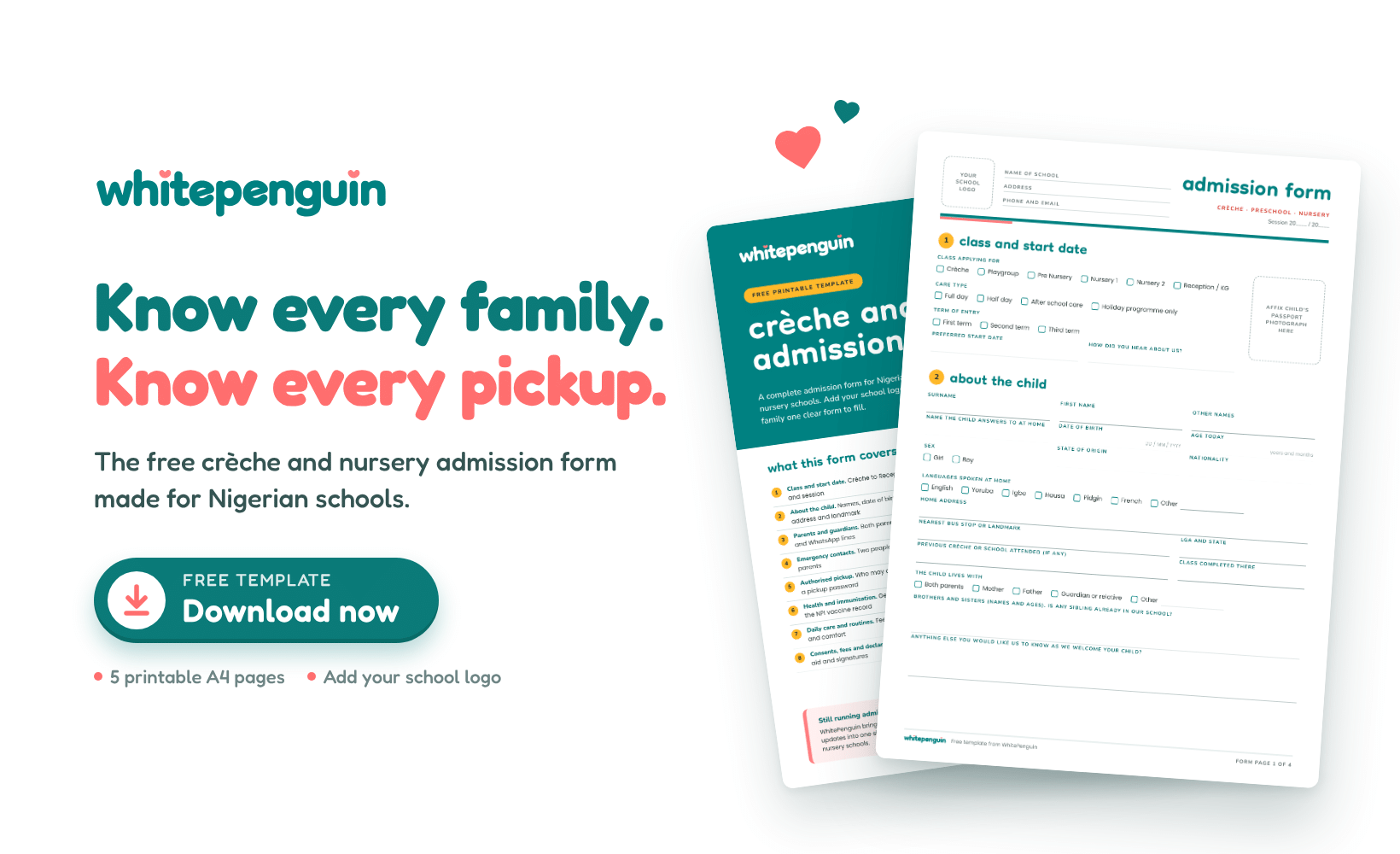
In this guide, you will learn exactly what a crèche and nursery school admission form in Nigeria should include, the local details most foreign templates leave out, and how to run a smooth admission season. At the end, you can download our free admission form template, ready to print with your own school logo.
What is a crèche admission form?
A crèche admission form is the document a parent fills when enrolling a child into your crèche, playgroup, preschool or nursery school. It records who the child is, who the family is, how to care for the child safely, and what the parents have agreed to.
In Nigeria, many schools sell the admission form as part of the registration process, then hold an assessment or a short visit before offering a place. Whether you charge for the form or give it free, the form itself is your first official record of that child.
Why every Nigerian crèche and nursery school needs a proper one
- Safety at pickup. You need a written list of who is allowed to collect the child, not a phone call from “Aunty”.
- Health emergencies. Allergies, genotype and medical conditions must be known before the child eats lunch on day one.
- Fewer fee disputes. When parents sign that they have seen your fee schedule and policies, arguments at the end of term reduce.
- Inspection readiness. Education officers who visit expect you to keep organised records for every child.
- A strong first impression. A clean, well designed form tells parents that your school is serious and well run.
What to include in a nursery school admission form: 10 sections
Our free template follows this exact order. Each section answers a question your team will ask at some point in the child’s life with you.
1. Class and start date
Ask which class the parent is applying for (Crèche, Playgroup, Pre Nursery, Nursery 1, Nursery 2 or Reception), the care type (full day, half day, after school care), the term of entry and the preferred start date. Add “How did you hear about us?” so you know which marketing is actually working.
2. About the child
Collect the full name with surname first, the name the child answers to at home, date of birth, age in years and months, state of origin and nationality. For crèche babies, age in months matters more than age in years, because it decides which room and routine the baby joins.
Always ask for the nearest bus stop or landmark as well as the home address. In many Nigerian cities, a landmark finds a house faster than a street number.
3. Parents and guardians
Give both parents equal space: full name, occupation, employer, office address, WhatsApp number, a second phone number and email. Then ask two questions that save you stress later: who should we call first, and who receives school fee invoices and receipts?
Also ask, gently, whether there is any court order or custody arrangement. It is rare, but when it exists, you must know.
4. Emergency contacts
List at least two people who are not the parents. Parents travel, sit in meetings and switch off phones. Ask where each contact lives or works, so you know who can reach the school fastest.
5. Authorised pickup persons
This is the most important safety section on the form. List every adult who may collect the child, including drivers, nannies and relatives, with a passport photograph and ID type for each. Add a family pickup password, a word only the family knows, which any new person must give before you release the child.
6. Health and immunisation
Record genotype, blood group, food and drug allergies, medical conditions, regular medicine, hospital or clinic, family doctor and HMO details. Then add an immunisation checklist based on the national schedule, so parents tick what their child has received from the immunisation card.
7. Daily care and routines
For babies and toddlers this section is gold. Ask about breast milk or formula, feeding times, foods the child must not eat, nap times, how the child falls asleep, toileting stage, the words the child uses for wee and poo, and the comfort item that comes from home. It turns a crying first week into a calm one.
8. Consents
Ask for clear yes or no answers on each item: photos in the private class WhatsApp group, photos on public social media, supervised outings, basic first aid, giving medicine provided by the parent, and emergency hospital treatment.
9. Fees and school policies
Record the admission or form fee, school fees per term, the due date and the payment plan. Then let parents tick that they have received your fee schedule, resumption and closing times, late pickup policy, sickness policy and withdrawal notice policy.
10. Declaration and office use
End with a short declaration that the information is true, space for both parents to sign and date, and a “For school use only” box for the admission number, receipt number, assessment date, class assigned and the documents you have received.
Nigerian details most free templates miss
Most admission form templates online were written for schools in America or the UK. They leave out things every Nigerian proprietor needs.
Genotype. Knowing whether a child is AA, AS, AC, SS or SC helps your team respond quickly and correctly if a child with sickle cell falls ill at school. Ask for it, and also ask what the family wants you to do in a crisis.
The national immunisation schedule. Nigeria’s routine schedule gives most vaccines at birth, 6, 10 and 14 weeks, then 9 and 15 months. Put these on the form so parents can copy straight from the immunisation card:
| Age | Vaccines |
|---|---|
| At birth | BCG, OPV 0, Hepatitis B 0 |
| 6 weeks | Pentavalent 1, PCV 1, OPV 1, Rotavirus 1 |
| 10 weeks | Pentavalent 2, PCV 2, OPV 2, Rotavirus 2 |
| 14 weeks | Pentavalent 3, PCV 3, OPV 3, IPV, Rotavirus 3 |
| 9 months | Measles 1, Yellow fever, Meningitis |
| 15 months | Measles 2 |
Sources: routine schedule summary (PMC) and rotavirus introduction (WHO Africa). Always ask parents to attach a copy of the card rather than relying on memory.
Landmarks, not just addresses. “Opposite the filling station after the second roundabout” will find a home faster than a house number in many estates.
WhatsApp photo consent. Nigerian schools share a lot through class WhatsApp groups. Ask separately for consent to share photos privately with parents and to post them publicly on Instagram or Facebook. Many parents say yes to one and no to the other.
Drivers, nannies and relatives. Many children are picked up by a driver, a house help or an uncle. Every one of them belongs on the authorised pickup list, with a photo.
Languages at home. A child who hears mostly Yoruba, Igbo, Hausa or Pidgin at home settles faster when caregivers know a few of the words the child uses.
Data protection. The Nigeria Data Protection Act 2023, signed in June 2023, applies to schools that collect personal information. Add a short line telling parents you keep their information private and use it only to care for their child.
How to run a smooth admission process for the new term
Second term resumes in January for most Nigerian schools, and parents start asking about places in November and December. Here is a simple process you can follow.
- Prepare your pack. Print the admission form with your logo, your fee schedule, your resumption and closing times, and your key policies. Keep a few copies at the gate and a PDF ready to send on WhatsApp.
- Collect the form and the documents together. Do not accept a form without the birth certificate, immunisation card and photographs. Use the checklist on the first page of our template.
- Book a visit or assessment. For crèche babies, a settling visit with a parent present works better than a test. For Nursery 1 upward, a short, play based assessment is enough.
- Read the health and routine pages with your caregiver. The person who will care for the child must see the allergies, genotype and routines before day one, not after.
- Confirm the place in writing. Send an offer message or letter with the class, start date, fees and due date.
- Set up the child’s file. Store the signed form, attachments and receipt in one folder, and record the admission number.
- Update every term. Ask parents to confirm phone numbers and pickup names at each resumption. Old numbers are one of the most common problems in an emergency.
Common admission form mistakes to avoid
- One parent only. If only Mummy’s details are on the form, you have no one to call when her line is busy.
- “Anybody can pick him.” A blank pickup section is a safety risk. Insist on names and photos.
- Allergies written as “none” without asking. Ask about food, drugs, plasters and insect bites separately. Parents remember more when you name the options.
- No consent for photos. Posting a child on your school Instagram without written consent can cost you a family’s trust.
- Forms that never get updated. A form from 2024 with an old number is almost as useless as no form.
- Paper that gets lost. Rain, termites, a misplaced file. If the only copy of a child’s allergy list is on paper, keep a scanned or digital copy too.
Paper forms or digital records?
A printed admission form is a great start, and many parents still prefer to fill one by hand. The challenge comes later. When a child falls ill at 11am, your caregiver should not be searching a cabinet for the allergy page. When fees are due, you should not be flipping through forms to find who receives the invoice.
That is why growing crèches and nursery schools move their records online. WhitePenguin brings child records, attendance, school fees and parent updates into one simple app built for Nigerian crèches, preschools and nursery schools. The information on this form lives in one place your whole team can reach, and parents stay updated without endless WhatsApp messages.
Book a free WhitePenguin demo to see how it works for your school.
Frequently asked questions
What documents should parents submit with a crèche admission form in Nigeria?
Ask for a copy of the birth certificate, a copy of the immunisation card, two recent passport photographs of the child, passport photographs of every authorised pickup person, a valid ID for each parent such as the NIN slip, and the last report or transfer letter if the child is moving from another school.
Should a crèche charge for its admission form?
Many Nigerian schools charge a form or registration fee, while others give the form free to attract more families. Either way, record the amount and receipt number on the form so your accounts stay clean.
At what age can a child start crèche in Nigeria?
It depends on your school. Many crèches take babies from about 3 months, often when a mother’s maternity leave ends. State the ages you accept for each class clearly on your form and website.
Is genotype really necessary on a nursery school admission form?
Yes. Knowing a child’s genotype helps your team recognise and respond to a sickle cell crisis quickly. Keep it private and share it only with staff who care for the child.
How often should parents update the admission form?
At least once a term, usually at resumption. Ask parents to confirm phone numbers, pickup persons and any new health information.
Can I edit this admission form for my school?
Yes. The template has a space for your school logo, name and address on every page. Print it as it is, or use it as a guide for your own form.
Download Your Free Crèche and Nursery Admission Form
WhitePenguin builds practical, Nigeria specific tools for crèche and preschool owners who take safety seriously. Our free admission form covers everything in this guide, from authorised pickup to the national immunisation schedule, and is ready to print with your school logo.