



You love children, and people around you keep asking where they can leave their babies while they go to work. Maybe you already look after a few children at home, and now you want to start a crèche in Nigeria and turn it into a proper business.
Starting a crèche in Nigeria can be one of the most rewarding businesses you will ever run. It is also one of the most demanding, because parents are trusting you with the most precious thing they have. The crèches that do well get the foundations right from day one: the right registration, a safe building, trained caregivers and simple systems that keep parents informed.
This guide shows you how to start a crèche in Nigeria, step by step, from registering your business name to welcoming your first families.
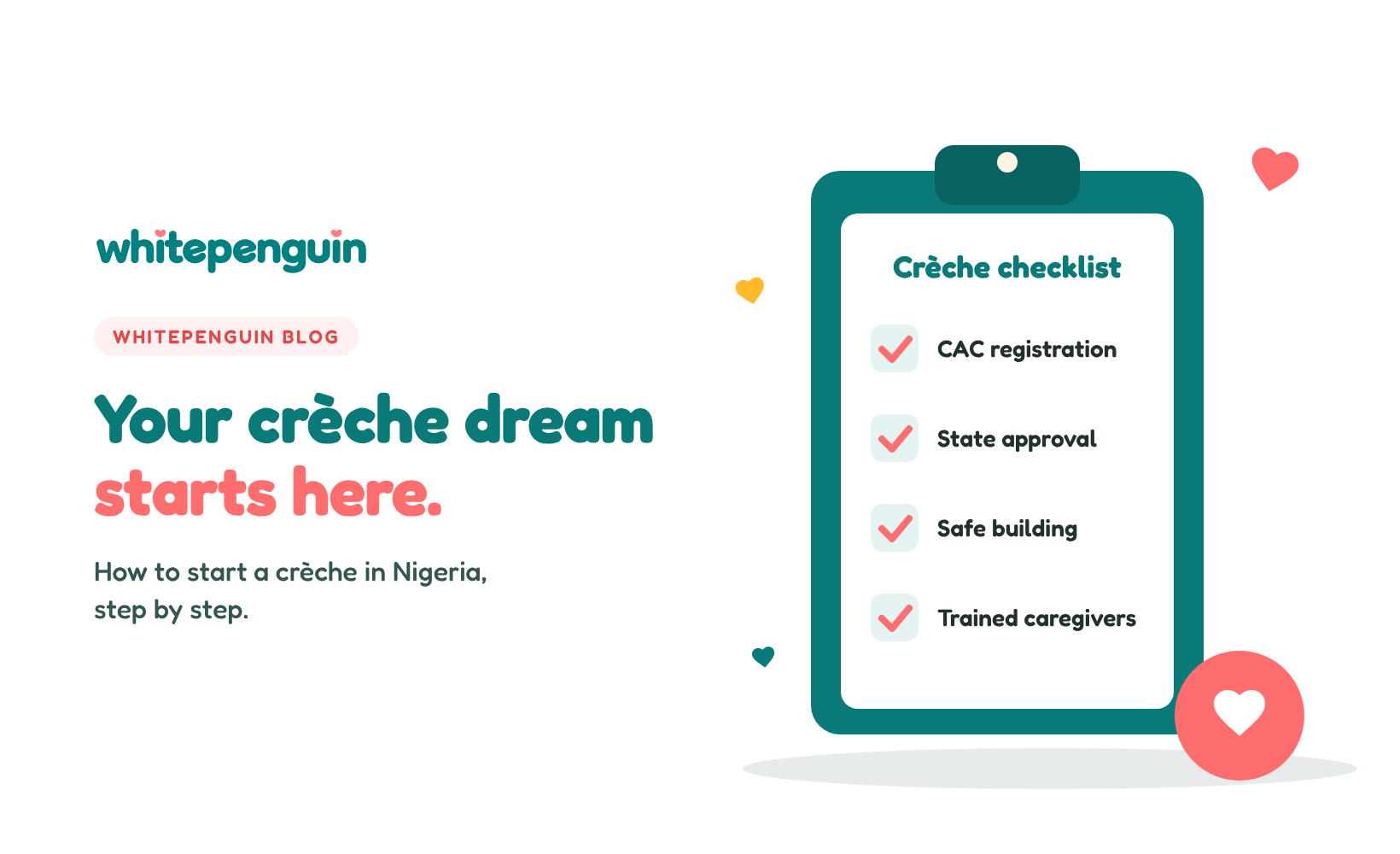
How to start a crèche in Nigeria: the short version
- Decide what kind of crèche you will run and which ages you will take.
- Study your area: demand, competition and what parents pay.
- Write a simple business plan and startup budget.
- Register your business with the Corporate Affairs Commission (CAC).
- Apply for approval from your State Ministry of Education.
- Prepare a safe, child friendly building.
- Hire, check and train your caregivers.
- Choose your curriculum and daily routine.
- Set your fees and write your school policies.
- Set up admissions, records and parent communication.
- Market your crèche and open your doors.
Is a crèche a good business in Nigeria?
The demand is real. More mothers in Nigerian cities work outside the home, many families no longer live close to grandparents who can help, and parents are more aware than ever that the early years shape a child’s future.
There is also a big gap to fill. In September 2026, the Universal Basic Education Commission (UBEC) reported that only 35.6% of Nigerian children aged 36 to 59 months attend any early childhood education, which leaves about 10 million young children outside the system. Families everywhere need safe, quality and well run early years centres.
Be realistic, though. A crèche is a people business with high running costs. Your biggest expenses will be staff and rent, and your profit depends on two things: how full your classes are and how reliably parents pay. Plan for both from the start.
Crèche, daycare or nursery school: what is the difference?
Parents in Nigeria often use these words interchangeably, but it helps to be clear about what you are offering.
| Type | Usual ages | What it offers |
|---|---|---|
| Crèche | About 3 months to 2 years | Care for babies and young toddlers: feeding, sleep, nappy changes, cuddles and early play. |
| Daycare | Babies to 5 years | All day care, often with long opening hours for working parents. |
| Nursery school or preschool | About 2 to 5 years | Structured early learning in classes such as Playgroup, Pre Nursery, Nursery 1 and Nursery 2, before Primary 1. |
| After school club | School age children | Care, homework support and activities after the school day. |
Many successful owners start with a crèche and add Toddler, Playgroup and Nursery classes as their first babies grow. If that is your plan, choose a building and a name that can grow with you.
Step 1: Decide what kind of crèche you will run
Before you spend any money, answer these questions:
- Which ages will you take? Babies under one year need the most staff, space and equipment.
- What hours will you open? Working parents in cities like Lagos and Abuja often need a crèche that opens early and closes late.
- Where will you run it? A home based crèche costs less to start, while a standalone building gives you more room to grow.
- What will make you different? It might be a Montessori approach, a faith based ethos, bilingual care, daily photo updates or simply excellent hygiene.
- Who are your parents? Premium and affordable crèches need very different buildings, staff and fees.
Step 2: Research your area and your competition
Visit the crèches and nursery schools near your chosen location. Find out what they charge, what hours they open and what parents like or complain about. Talk to parents in your estate, church or mosque, and at nearby offices and hospitals.
Look for gaps you can fill. Perhaps nobody in the area takes babies under six months, nobody opens before 7am, or nobody tells parents how their child’s day went. Those gaps become your selling points.
Choose your location carefully. The best spots are close to homes and workplaces, easy to reach for drop off and pickup, secure, and away from busy roads and noisy markets.
Step 3: Write a simple business plan and startup budget
Before you start a crèche in Nigeria, put your plan on paper. Your business plan does not need to be 50 pages. It should explain who your parents are, what you will offer, what you will charge, how many children you need to break even, what it will cost to start and run, and how you will attract families.
Use this table to build your startup budget:
| Cost area | What to budget for |
|---|---|
| Registration and approval | CAC registration, state approval and inspection fees, and any legal or consultant fees. |
| Rent and renovation | Rent, which is often paid one or two years upfront, plus painting, partitioning, fencing and child safe fittings. |
| Power and water | Generator, inverter or solar system, water storage and clean drinking water. |
| Furniture and equipment | Cots, mattresses, high chairs, changing tables, low shelves, play mats and a fridge for milk and food. |
| Learning materials | Toys, books, puzzles, art supplies and outdoor play equipment. |
| Safety and health | Fire extinguishers, smoke alarms, first aid kits, CCTV and a secure gate. |
| Staff | Salaries for caregivers, a cleaner, a cook and security, including the months before your classes are full. |
| Marketing | Signboard, flyers, social media, an open day and a simple website or Google Business Profile. |
| Systems | Software for admissions, fees, attendance, daily reports and parent communication. |
Prices change quickly in Nigeria, so get fresh quotes and check the latest inflation figures from the National Bureau of Statistics before you finalise your numbers. Most importantly, keep enough money aside to pay salaries and running costs for at least three to six months while enrolment grows.
Step 4: Register your crèche with the CAC
When you start a crèche in Nigeria, it must be a registered business. In Nigeria, business registration is handled by the Corporate Affairs Commission (CAC), and you can now apply online with your National Identification Number (NIN).
You have two main options:
- Business name: simpler and cheaper, and a good fit for a single owner starting small.
- Private limited company (Ltd): separates your personal assets from the business, and makes it easier to bring in partners, raise money or open more branches later.
Once registered, open a business bank account in the crèche’s name so that all fees are paid into one place. This makes your records cleaner and builds trust with parents.
Step 5: Get approval from your State Ministry of Education
CAC registration lets you operate as a business, but it is not approval to run a school. Anyone who wants to start a crèche in Nigeria also needs approval from their state. Every state regulates private crèches, nursery and primary schools through its Ministry of Education or quality assurance agency.
In Lagos, for example, private schools below tertiary level are registered and monitored by the Office of Education Quality Assurance (OEQA). The state has made it clear that registration is mandatory for all private schools and failure to comply may attract sanctions. Approved schools must also follow the Lagos State School Safety Initiative and allow officials in for routine assessments.
Lagos has also directed schools to capture each learner’s LASRRA registration number in admission records from the 2026/2027 session, so make sure your crèche admission form has space for it.
The process differs from state to state, but it usually looks like this:
- Get the application form and guidelines from your state ministry or quality assurance office.
- Submit your documents, such as your CAC certificate, proposed school name, building or lease documents, staff list and qualifications, and curriculum.
- Prepare for an inspection of your premises.
- Pay the approval fee to the state government.
- Receive your approval letter, then renew it whenever your state requires.
In some states, centres that care for very young babies may also deal with the Ministry of Women Affairs or Social Welfare. Requirements and fees change often, so always confirm directly with your state office before you pay anyone.
Step 6: Prepare a safe, child friendly building
Safety is the first thing to get right when you start a crèche in Nigeria. It is what parents check first, and it is what inspectors look for. UBEC has asked states to make sure early childhood centres meet standards on child safety, supervision, safeguarding, food and water safety, structural safety and emergency exits.
Use this checklist when preparing your building:
- A secure perimeter fence and a gate that is always manned.
- Clear emergency exits, working fire extinguishers and a written fire drill plan.
- A quiet sleep room with cots spaced well apart.
- A clean nappy changing area with handwashing close by.
- A separate, hygienic kitchen or milk preparation area.
- Safe drinking water and child sized toilets and sinks for toddlers.
- Covered sockets, no sharp edges, secure windows and safety gates on stairs.
- A shaded, fenced outdoor play area.
- Reliable power for fans, lighting and the fridge.
- CCTV in shared areas, which many parents now expect.
Step 7: Hire, check and train your caregivers
Your caregivers are your crèche. Parents will forgive an old building long before they forgive a careless nanny. Look for warmth, patience, honesty and experience with babies. A Nigeria Certificate in Education (NCE) in Early Childhood Care and Education is a strong plus, especially for your head of centre.
- Check everyone carefully. Collect references and guarantors, call previous employers and keep copies of identification for every staff member.
- Train before day one. Cover first aid, safe sleep, hygiene, feeding, child protection and how to speak to parents.
- Plan enough adults. Babies need far more attention than older children. Follow your state’s guidelines, and as good practice, many quality centres plan about one caregiver for every three or four babies.
- Write it down. Give every staff member a job description and a code of conduct, and never allow one adult to be alone with children out of sight.
Step 8: Choose your curriculum and daily routine
Even the youngest babies are learning every minute. A good crèche has a predictable daily routine: arrival, feeding, play, outdoor time, songs and stories, nap time and a calm handover at pickup.
As your children grow into Playgroup and Nursery classes, align your learning with the national early childhood and pre primary curricula developed by the Nigerian Educational Research and Development Council (NERDC). Track each child’s progress so you can spot concerns early and show parents how their child is growing. Our guide to tracking child milestones in Nigerian preschools explains how, and WhitePenguin Learning helps you plan lessons and record progress in one place.
Step 9: Set your fees and write your policies
Do not try to be the cheapest crèche in town. Low fees make it hard to pay good caregivers, keep the building safe and survive rising costs. Set your fees by looking at three things: what it costs you to care for each child, what similar crèches nearby charge, and the value you offer that others do not. Our free webinar, Preschool ROI Trumps College by 650%, explains how to help parents see your fees as an investment.
Write clear policies and share them with every family at admission:
- Fees, payment dates, instalments and late payment.
- Late pickup and who is allowed to collect each child.
- Sickness, medication and when a child must stay at home.
- What parents provide, such as nappies, wipes, formula and spare clothes.
- Opening hours, holidays and closures.
- How you collect, store and share children’s information.
Getting fees right from the start saves you many sleepless nights. Read our tips on how to get parents to pay school fees on time, see our school fees reminder letter examples, and see how WhitePenguin Billing sends invoices and reminders for you.
Step 10: Set up admissions, records and parent communication
Good records protect the children, your staff and your business. From your very first family, keep:
- Admission forms with health, allergy and emergency contact details.
- Daily attendance with drop off and pickup times.
- Daily reports on meals, naps, nappies and mood.
- Incident, accident and medication records.
- Staff files and training records.
Parents of babies want to know how their child’s day went. Our guide to the crèche daily report sheet shows what to include in a daily update.
Remember that you are holding sensitive information about children and families. The Nigeria Data Protection Act 2023 applies to personal data, and the Nigeria Data Protection Commission publishes guidance on keeping it safe. Exercise books and WhatsApp threads get lost. A secure system such as WhitePenguin Admissions and WhitePenguin Communication keeps records organised and gives every parent daily updates without extra paperwork.
Step 11: Market your crèche and open your doors
You do not need a big budget to fill your first classes. Start with:
- A clear signboard and a Google Business Profile so parents can find you on Google Maps.
- Instagram, Facebook and WhatsApp Status posts showing your clean, bright rooms and happy caregivers.
- Flyers in nearby estates, offices, hospitals, churches and mosques.
- An open day where parents can meet your team and see the space.
- A referral reward for families who bring a friend.
Your first families are your best marketing. Look after them well and they will tell everyone. For more ideas, read 12 ways to increase enrolment in your preschool in Nigeria.
Common mistakes to avoid when you start a crèche in Nigeria
- Opening before approval. It can lead to sanctions or closure, and it worries parents.
- Charging too little. It is much harder to raise fees later than to price fairly from the start.
- Hiring in a hurry. One bad hire can damage your reputation for years.
- Taking too many children too soon. Grow only as fast as your staff and space allow.
- No written policies. Without them, every late payment or late pickup becomes an argument.
- Keeping records on paper only. Paper gets lost, and parents increasingly expect digital updates.
Frequently asked questions
How much does it cost to start a crèche in Nigeria?
It depends on your city, building and size. Your biggest costs will be rent and renovation, furniture and equipment, staff salaries for the first few months, and registration and approval fees. Write a startup budget, get fresh quotes, and keep enough money to cover three to six months of running costs while enrolment grows.
Do I need to register my crèche with the government?
Yes. Register your business with the Corporate Affairs Commission (CAC), then apply for approval from your State Ministry of Education or quality assurance agency. In Lagos, private schools are registered and monitored by the Office of Education Quality Assurance (OEQA), and registration is mandatory.
Can I start a crèche in my home in Nigeria?
Many owners start with a home based crèche. You still need to register your business, get state approval and make sure the space meets safety standards for fencing, emergency exits, hygiene and sleep areas. Check your state guidelines before you begin.
What qualifications do I need to open a crèche in Nigeria?
Requirements differ by state. Your head of centre and caregivers should have early childhood training, such as an NCE in Early Childhood Care and Education, plus first aid training. Confirm the exact staffing requirements with your state ministry.
How many children can one caregiver look after?
It depends on the children’s ages and your state’s guidelines. Babies need the most attention, and many quality centres plan about one caregiver for every three or four babies, with more children per adult as they get older.
How long does it take to get crèche approval in Nigeria?
It varies by state and can take from a few weeks to several months, because your premises must be inspected and your documents reviewed. Start the process early and do not open to families before you are approved.
Run your new crèche on WhitePenguin
Starting a crèche is hard enough without juggling paper forms, fee notebooks and endless WhatsApp messages. WhitePenguin for school owners brings admissions, billing, attendance, daily reports, learning and parent communication into one simple app built for Nigerian crèches, preschools and nursery schools. If you are ready to start a crèche in Nigeria, start with the right systems from day one and grow with confidence.
Opening a crèche soon? Book a free WhitePenguin demo and see how it can run your school from your very first family.